AussieBT Complaints and Reputation: Documented Australian Cases
 Available in AU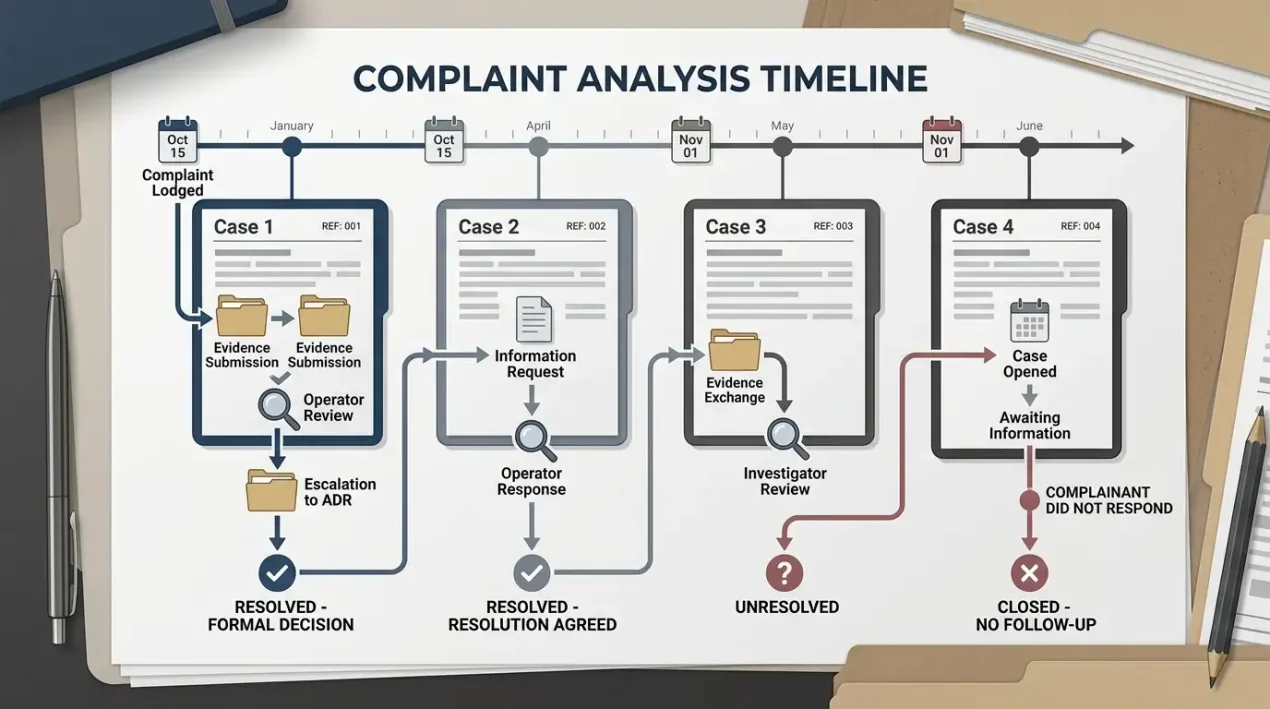
Contents
Complaint chronology and evidentiary limits
Casino Guru currently lists four AussieBT complaints in its database: three unresolved and one rejected. The documented set includes Australian-player cases involving disputed amounts of A$31,000, A$23,132, A$8,600 and A$652. The three unresolved records involve large disputed winnings or withdrawals; the A$652 complaint was closed after the player stopped responding.
These are complaint-platform records, not a finding that every AussieBT account will experience the same problem. The useful reputation signal comes from the dates, amounts, operator-response pattern and the platform’s stated reason for each outcome. Player allegations remain allegations unless independently established, and player-specific statements about payout limits or processing times are not treated as current casino terms.
Current complaint picture
The Casino Guru review checked on 19 September 2026 shows four complaints in total, with zero opened, three unresolved, zero resolved and one rejected. That aggregate is useful because it gives a dated snapshot of the platform’s complaint record rather than relying on isolated forum posts or user-review headlines.
The three unresolved cases are not identical. One concerns a 2026 dispute over A$31,000 in winnings and account closure. Two older Australian cases concern delayed or non-received withdrawals of A$23,132 and A$8,600. The fourth complaint, involving A$652, was not closed as an unresolved operator dispute. It was closed after the player stopped responding, which is a materially different outcome.
That distinction is central to interpreting reputation evidence. Counting all four cases as if they proved the same thing would be misleading. The case chronology below preserves the platform’s own status and reason for closure while keeping the underlying player claims attributed.
Case 1: A$31,000 winnings and account closure in 2026
Casino Guru records an Australian complaint submitted on 1 April 2026 involving A$31,000. The player alleged that winnings were confiscated and the account was closed after the casino referred to suspicious betting activity. Those are the player’s allegations and should not be restated as an independently proven finding.
The complaint platform closed the case as unresolved on 16 April 2026. Its published case summary says the unresolved outcome reflected the casino’s lack of cooperation and failure to provide supporting evidence despite attempts to obtain its position. Later in the thread, the complaint handler explicitly clarified that unresolved did not mean the player’s claim had been proven or invalidated; it meant there was not enough cooperation and verifiable documentation for a proper assessment.
That makes the case relevant to reputation for two reasons. First, the disputed amount is substantial. Second, the published closure reason describes limited operator cooperation during the complaint process. The evidence does not justify a universal statement that AussieBT confiscates large wins, but it does justify recording the unresolved dispute and the platform’s stated inability to obtain enough information from the casino.
Case 2: A$23,132 withdrawal complaint from 2024
Casino Guru records another Australian complaint with a disputed amount of A$23,132, submitted on 5 June 2024 and marked unresolved on 12 July 2024. The player alleged that a withdrawal had not been received and that the casino’s explanation about payment changed over time.
The platform’s case summary says it attempted to contact the casino but did not receive a meaningful response, and the complaint was marked unresolved. That operator-response element is more useful for reputation analysis than treating the player’s description of timing, Osko processing or payment confirmation as universal casino policy.
This is why the withdrawal evidence page does not publish an exact AussieBT payout time or limit from this case. A complaint can document a dispute without establishing current cashier terms. The platform record supports the existence and unresolved outcome of the dispute, not a general payout timetable.
Case 3: A$8,600 withdrawal complaint
A third Australian case was submitted on 14 May 2024 with a disputed amount of A$8,600. Casino Guru later marked it unresolved on 20 January 2025. The player alleged that two withdrawals had not arrived and that the casino stopped responding after saying payments had been made.
The complaint platform’s published record says repeated attempts to contact the casino were unsuccessful. The case was therefore closed unresolved. As with the A$23,132 case, the important evidence is the complaint’s status, chronology and documented response pattern, not an assumption that the same result follows for every withdrawal.
When several unresolved cases involve similar operational areas, the pattern becomes more relevant as a due-diligence signal. It still does not remove the need to evaluate each case separately, because disputed amounts, account histories, evidence and complaint handling can differ.
Case 4: A$652 complaint closed after the player stopped responding
The fourth complaint involved A$652 and was submitted in September 2025. The player reported a withdrawal delay of roughly two days. Casino Guru asked the player to allow more time and to provide follow-up information if the issue remained unresolved.
The player then stopped responding to the complaint platform’s messages and reminders. Casino Guru closed the complaint on 28 September 2025 because it could not continue the investigation without the player’s participation. In the aggregate AussieBT tally, this is the single rejected complaint.
This record should not be merged with the three unresolved cases. A complaint closed for lack of player response does not carry the same operator-response signal as a case closed after unsuccessful attempts to obtain cooperation or evidence from the casino. Treating the statuses separately gives readers a more accurate picture than quoting a raw total alone.
Complaint summary table
| Disputed amount | Submitted | Platform outcome | What the record supports |
|---|---|---|---|
| A$31,000 | 1 Apr 2026 | Unresolved, 16 Apr 2026 | Documented winnings/account dispute; platform cites insufficient casino cooperation and supporting evidence. |
| A$23,132 | 5 Jun 2024 | Unresolved, 12 Jul 2024 | Documented withdrawal dispute; platform records unsuccessful attempts to obtain a meaningful response. |
| A$8,600 | 14 May 2024 | Unresolved, 20 Jan 2025 | Documented withdrawal dispute; platform says repeated contact attempts were unsuccessful. |
| A$652 | 12 Sep 2025 | Closed, 28 Sep 2025 | Complaint closed after the player stopped responding; not the same evidentiary outcome as the unresolved cases. |
What the three unresolved cases mean
Unresolved complaints matter because they show that a dispute was not brought to a successful resolution through the complaint platform. Where the platform records unsuccessful attempts to obtain a response or sufficient evidence from the operator, that response behaviour is itself relevant to a reader assessing escalation risk.
The status is not a court finding, regulator decision or independent proof of every allegation. Casino Guru’s own complaint methodology distinguishes resolved, rejected and unresolved cases and explains that unresolved can apply when the platform believes further operator cooperation is necessary but the dispute remains unsettled.
For AussieBT, the current record therefore supports a measured reading: there are multiple dated unresolved Australian complaints, including large disputed amounts, and the published case records describe difficulties obtaining sufficient operator cooperation in those cases. It does not support saying that every withdrawal is withheld, that every account is closed after a win, or that every player allegation has been independently proven.
Why complaint recency matters
The 2026 A$31,000 case is more recent than the two unresolved 2024 withdrawal complaints. Recency matters because an operator’s support structure, ownership, licensing or payment systems can change over time. A newer case can therefore carry more weight when assessing current complaint-handling behaviour, while older cases remain part of the historical pattern.
At the same time, a recent complaint should not erase the older records. When the older and newer cases all include an unresolved outcome, the chronology gives a reader more information than a single snapshot. The useful question is not simply how many complaints exist, but whether response behaviour improves, worsens or remains unresolved across time.
Any future update to this page should repeat the count and status check rather than assuming today’s tally will remain fixed.
How to read operator response as a reputation signal
A complaint platform is most informative when it records both sides of a dispute. If the operator responds with transaction records, account logs, terms or a reasoned explanation, the platform has more material to assess. If the operator does not respond or does not provide enough documentation, the platform may be unable to test the player’s version fully.
That is why no-reaction or insufficient-cooperation outcomes matter even when the underlying allegation remains unproven. They tell the reader something about the practical difficulty of resolving a dispute through that channel. They should be recorded accurately without upgrading them into accusations of fraud or systematic misconduct.
For account verification and support-channel context, see the account verification guide. It explains which support and KYC claims are supported and which details remain unverified.
Keep complaint evidence separate from licence evidence
Some Casino Guru complaint summaries refer to licensing concerns, but this page does not use a complaint platform to establish Australian licensing. The separate licence checks page uses regulator evidence for that question and records that no AussieBT or Aussiebt match was found in the ACMA register during the current check.
This separation matters because the absence of a verified local licence and the existence of unresolved complaints are two different trust signals. They can be considered together by a reader, but one should not be used as proof of the other. The same rule applies to product features: a complaint does not by itself establish current payment limits, and a payment method does not establish regulatory protection.
The legal position for providers offering online casino services to people in Australia is covered separately on the Australian consumer context page.
A due-diligence checklist for review-platform complaints
Complaint pages are easiest to misuse when readers focus only on the headline or disputed amount. A better review process checks the full case record.
- Confirm the date. Newer cases are usually more relevant to current operations than very old complaints.
- Separate allegation from platform finding. Note what the player says and what the platform independently says about the evidence or response process.
- Check the closure reason. Unresolved, rejected and resolved are not interchangeable outcomes.
- Look for operator participation. A reasoned response with evidence is different from no reaction or incomplete cooperation.
- Do not generalise player-specific terms. A claimed payout limit, timing promise or verification request in one thread is not a universal current term.
- Check corroboration. Regulator records, official terms and transaction evidence can strengthen or weaken the significance of a complaint.
What this complaint record does not establish
The complaint evidence does not establish an exact current withdrawal limit, processing time or fee. Those are residual high-risk payment facts and need current official cashier or terms evidence. It does not prove that every AussieBT player experiences delays, account closure or confiscation. It does not turn third-party review scores into this site’s own rating.
It also does not establish current Australian registration acceptance. Current operational availability is treated as a separate high-risk question because a resolving branded domain, historical player activity and complaint records do not prove that a new Australian account can be opened today.
Keeping those boundaries clear makes the complaint record more useful, not less. Readers can see exactly what happened in the documented cases without being pushed toward unsupported generalisations.
Practical view of AussieBT complaints
The current Casino Guru record contains four AussieBT complaints: three unresolved and one rejected. The unresolved cases include an A$31,000 dispute submitted in 2026 and two Australian withdrawal disputes of A$23,132 and A$8,600 from 2024. The A$652 complaint is different because it was closed after the player stopped responding.
The reputation signal is therefore the combination of multiple unresolved Australian cases, substantial disputed amounts and published records describing limited operator cooperation in those unresolved cases. The evidentiary limit is equally important: these records do not prove universal payout behaviour, and the underlying player allegations should remain attributed. For the wider product and evidence picture, return to the AussieBT review.
FAQ
How many AussieBT complaints are listed by Casino Guru?
At the 19 September 2026 check, Casino Guru listed four complaints: three unresolved and one rejected.
Are the complaint allegations proven facts?
No. The existence, dates, disputed amounts and platform outcomes are documented, but player allegations remain attributed unless independently established.
Why is the A$652 complaint treated differently?
Casino Guru closed that case after the player stopped responding, so it does not carry the same operator-response signal as the three unresolved cases.
Do the complaints prove AussieBT’s current withdrawal limits or processing times?
No. Player-specific statements in complaint threads are not used as current universal payout terms. Exact limits, fees and processing times require current official evidence.
This material was created by the AussieBT Australia Guide team.
Related posts
AussieBT and Australian Online-Casino Rules: ACMA, BetStop and Tax
AussieBT Withdrawals: What Is Verified About Cashouts and Delays